The Unprecedented Crackdown on refugees and migrants in Egypt

Overview
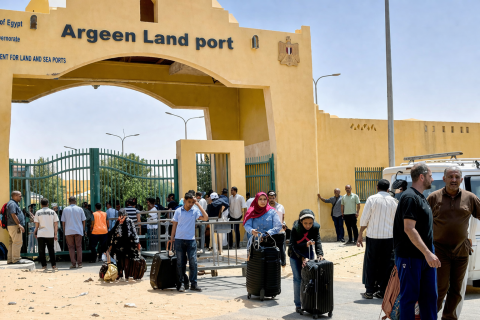
Egypt’s crackdown on refugee and migrant communities has taken an extreme turn since the start of 2026, reaching crisis levels. Denial of access to police stations and border areas makes it impossible to obtain comprehensive figures on detention and deportation. Nevertheless, available data indicates a dramatic escalation. Sources from UNHCR estimated the arrest of at least 3,000 refugees and asylum seekers in the first two months of the year, while some lawyers estimated the number of arrested refugees and asylum seekers to be between 5,000 and 10,000. One local protection actor estimates that close to 5,000 refugees were arrested in a two-week period beginning in the third week of January, the majority of them Sudanese. As a result, members of refugee and migrant communities are now afraid to leave their homes.
Since mid-2024, Egyptian authorities have waged an indiscriminate campaign against refugees and migrants, subjecting them to administrative detention and deportation regardless of legal status. This escalation amounts to what we have previously described as the collapse of a refugee protection system that had functioned for decades.
In October 2025, four UN Special Rapporteurs expressed deep concern over the widespread escalation of arbitrary detention and forced deportation in a communication addressed to the government of Egypt. They highlighted a 150 percent increase in refoulement incidents involving registered refugees between 2024 and 2025, alongside a 56 percent rise in arrests of registered refugees and asylum seekers. In December 2025, the government responded to the Special Rapporteurs in a letter confirming its full respect of international protection, and denying involvement in any refoulement of registered asylum seekers or refugees or the detention and deportation of children. Despite the official denial, the campaign targeting refugees and migrants intensified with the start of 2026 reaching unprecedented levels, leading to the publication of a new statement by four UN experts and Special Rapporteurs expressing continued concerns over the unprecedented escalation of arbitrary arrests and unlawful deportations, accompanied by human rights violations against refugees, asylum seekers, and migrants in Egypt.
Detention and Refoulement
Since early 2026, authorities have intensified immigration raids targeting refugee and migrant communities. The scale, consistency, and geographic spread of the arrests point to the implementation of an official policy by the Ministry of Interior involving recurring residency and documentation checks. Lawyers working on immigration detention have seen official police documents containing instructions to systematically target refugee and migrant communities.
Authorities have conducted door-to-door checks, resulting in arrests inside private homes. Arrests have also occurred at random street checkpoints, on public transportation, in schools, universities, and workplaces. In several instances, checkpoints were established outside refugee schools and service provider premises. Some individuals were arrested while seeking police protection or medical treatment at public hospitals. Children in school uniform and university students with valid documentation and residency, women, elderly persons, and persons with disabilities have all been detained. In many cases, individuals appear to have been stopped and arrested solely on the basis of skin color or perceived nationality.
In its official response, the government of Egypt states “[n]o one is arrested for being a refugee or asylum-seeker but only for violating residency laws”. Indeed lack of residency is the main cause—90%—for arrests among refugees and asylum seekers. Approximately 80% of refugees do not hold valid residency permits issued by the Ministry of Interior due to appointment backlogs extending into 2029. Waiting periods are expected to decrease in the future with additional processing capacity, but will remain at 19 months, forcing refugees into a condition of forced irregularity that is then used to justify their administrative detention. The campaign has also targeted documented refugees carrying valid UNHCR identification and residency permits. During arrests, authorities have reportedly confiscated and destroyed UNHCR documents, as well as residency permits, leaving detainees unable to prove their status in official processing.
Although protected under international law from refoulement—as stated in the government’s official response to UN Special Rapporteurs—increasing numbers of UNHCR-registered refugees are being processed for deportation. Releases from administrative detention have become increasingly rare. All undocumented individuals and those arrested on suspicion of criminal activity, even if later exonerated, face deportation proceedings. Sudanese refugees have been disproportionately affected, despite UNHCR’s strict position confirming the international protection needs of Sudanese nationals. More recently, significant numbers of Syrian refugees have also been arrested and deported.
Testimonies and official documents further confirm that refugees processed for deportation are made to sign voluntary return declarations. Testimonies from deported refugees indicate the use of coercive practices, including torture, threats of prolonged detention, and inhumane detention conditions, to compel detainees to sign so-called voluntary return declarations, thereby obscuring unlawful refoulement. Despite Egypt’s stated prohibition on immigration detention of children, hundreds of children have been detained and deported without their parents.
In January 2026, a Sudanese child was arrested while purchasing food for his family, despite possessing valid UNHCR documentation and a scheduled residency appointment. He was held in overcrowded conditions in an open-air detention area, developed health complications, and died in February while awaiting deportation processing. Overcrowding has led authorities to transfer detainees to security force camps functioning as unofficial detention facilities. Access to healthcare in police stations is extremely limited, and detainees often rely on families for daily food provision. In February, an elderly Sudanese refugee died following denial of adequate medical care. These deaths, while preventable, are consistent with the scale and severity of the current campaign and the resulting strain on detention infrastructure. ٍSince the start of the year, protection actors have confirmed the deaths of seven refugees and migrants in detention in Egypt, of whom at least five were registered with UNHCR.
Taken together, the scale and indiscriminate nature of this campaign have effectively dismantled Egypt’s refugee protection framework. Refugees now face arrest and deportation while engaged in routine daily activities, such as attending school or work, seeking protection or medical care, or even staying at home.
Isolation and Erosion of Protection
Although official statements—including the government’s response to the Special Rapporteurs—continue to affirm refugees’ integration into public services, particularly health and education, since July 2024 authorities have denied access to public services for those without valid residency. Even prior to the most recent escalation, it was estimated that over 50 percent of UNHCR-registered refugee children were out of school due to residency-related administrative requirements. Health actors have documented hundreds of cases in which refugees were denied emergency, life-saving, and primary medical care due to documentation issues over the past 18 months.
The current crackdown has further eroded community-based services. Refugee-led learning centres established to compensate for barriers to public education have been shut down by authorities or have suspended activities to protect staff and students from arrest. Tens of refugee- and migrant-led organizations have similarly closed their centres or decreased activities due to security concerns.
Approaching UNHCR offices has itself become risky, as reports of arrests occurring near or outside UNHCR premises have increased. Fear of arrest has confined many refugees to their homes. Many have lost informal employment opportunities they had and cannot meet basic needs.
With limited access to police protection, UNHCR, or service providers, refugees face significant barriers to reporting crimes and seeking remedies. Protection actors have documented hundreds of cases in which refugee victims were denied police services. Survivors of gender-based violence and child abuse face heightened risk of re-exposure, due to lack of protection services, while impunity for crimes against refugees deepens. These cumulative factors have effectively isolated refugee communities from meaningful access to protection and accountability.
Escalation of Anti-Refugee and Anti-Migrant Rhetoric
The crackdown has coincided with a marked escalation in anti-refugee and anti-migrant rhetoric across social and traditional media. Although negative narratives have been present for several years, the past eight weeks have seen significant intensification, coinciding with the rise in arrests.
Hashtags calling for deportation, particularly targeting Sudanese and Syrian refugees, have repeatedly trended. Investigative reporting indicates that this surge is linked to coordinated online campaigns aimed at inciting hostility, spreading misinformation, and attributing Egypt’s economic difficulties to refugees and migrants. Within a six-day period, a primary deportation hashtag generated approximately 8,000 posts, engagement from 26,000 accounts, and reach exceeding six million users.
While such coordinated activity may not reflect broader public sentiment, its scale and organization demonstrate the capacity to shape public perception against refugees and migrants, and legitimize exclusionary policies.
Conclusion
Since the start of 2026, Egypt’s detention and deportation campaign has reached crisis proportions, in clear violation of its obligations under the 1951 Refugee Convention and other international human rights instruments. The scale, intensity, and systematic nature of the campaign during the first three months of 2026 have placed hundreds of thousands of refugees and asylum seekers at immediate risk of detention and refoulement.
This represents not only an operational crackdown but a structural dismantling of refugee protection in Egypt. It marks a departure from Egypt’s historical posture as a state comparatively accessible to refugees fleeing regional conflicts and constitutes a serious breach of international legal commitments, as recognized by the government in its response to the UN Special Rapporteurs.
Last month, the Egyptian Prime Minister appointed the Chair of the Permanent Committee for Refugee Affairs; the first step towards the implementation of the asylum law. The current violations raise serious concerns in light of the concrete steps taken to implement the asylum law. The same authorities implicated in refoulement and related violations would be tasked with administering that national asylum system. Without fundamental changes, to the provisions of the asylum law, and in policy and oversight, the prospects for a fair, transparent, and rights-compliant asylum framework remain improbable, if not unattainable.


